
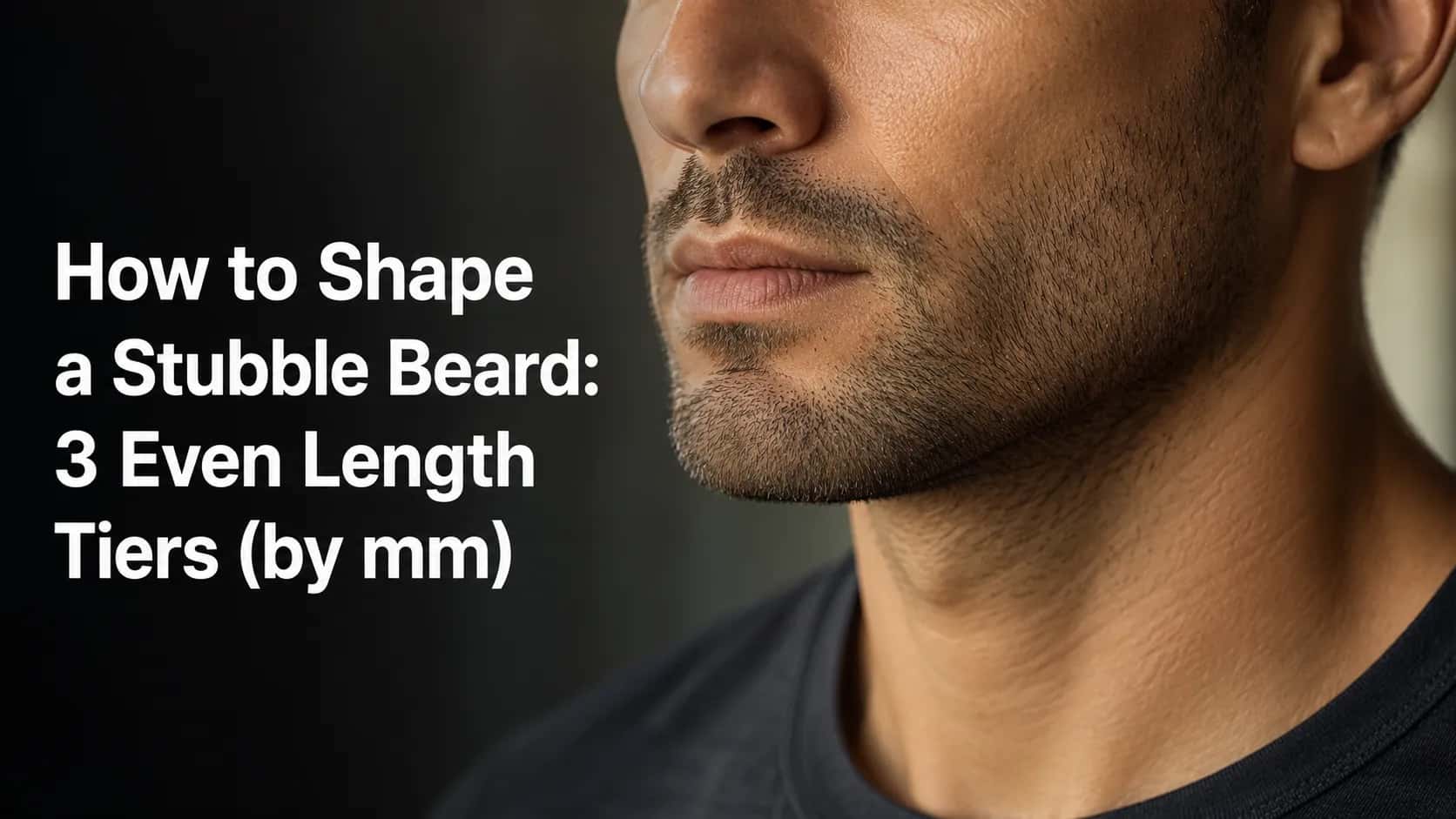
How to Shape a Stubble Beard: 3 Even Length Tiers (by mm)
Set your stubble to one even length across three tiers (light, medium, heavy mm), fix the patchy jawline, and learn how often to re-cut for a clean 3-day look.
Written by Andre ColemanReviewed by Russell Hartley
Last updated on July 14, 2026
When you buy through links on our site, we may earn an affiliate commission (at no extra charge), which we use to fund new product tests. Learn more.
Summarize with AI
Most guides treat stubble as the thing you get by not shaving. That framing is why so many men end up looking like they forgot to shave instead of like they meant it.
Stubble is a length you set, not a chore you skip. After running a single trimmer through one 14-day growth cycle and measuring the result by the millimeter, the pattern was obvious.
The whole look lives or dies on evenness, and holding it even takes more frequent upkeep than a short beard, not less. This guide on how to shape a stubble beard gives you three length tiers in millimeters, the step to set one even length, and the jawline fix nobody explains.
The 30-second version: Grow 3 to 5 days. Pick a tier, light 1 to 2 mm, medium 2 to 3 mm, or heavy 4 to 5 mm. Set your whole face to that one length, clean the neckline and cheeks, then re-cut every 2 to 3 days. The hard part is keeping it even around the jaw, which is its own section below.
The 30-Second Stubble Answer and What You Need
To shape a stubble beard, grow your facial hair for 3 to 5 days, choose one length tier in millimeters, then trim your entire face to that single length. Light stubble runs 1 to 2 mm, medium sits at 2 to 3 mm, and heavy reaches 4 to 5 mm.
The goal is one even length across the cheeks, chin, and jaw, not a tapered fade. Get that evenness right and the classic 3-day-beard look follows, with a re-cut every 2 to 3 days.
You need three things and no more. An adjustable trimmer that holds a precise length in small steps, a mirror with decent light, and a free hand to stretch the skin taut.
The trimmer is the part that matters. A model with 0.5 mm increments lets you land on an exact tier instead of guessing between bulky plastic guards.
Heads-up: the exact millimeter that looks right on you depends on hair density and color, so treat the tiers below as starting points, not laws.
Stubble Length Tiers: Light, Medium and Heavy (by mm)
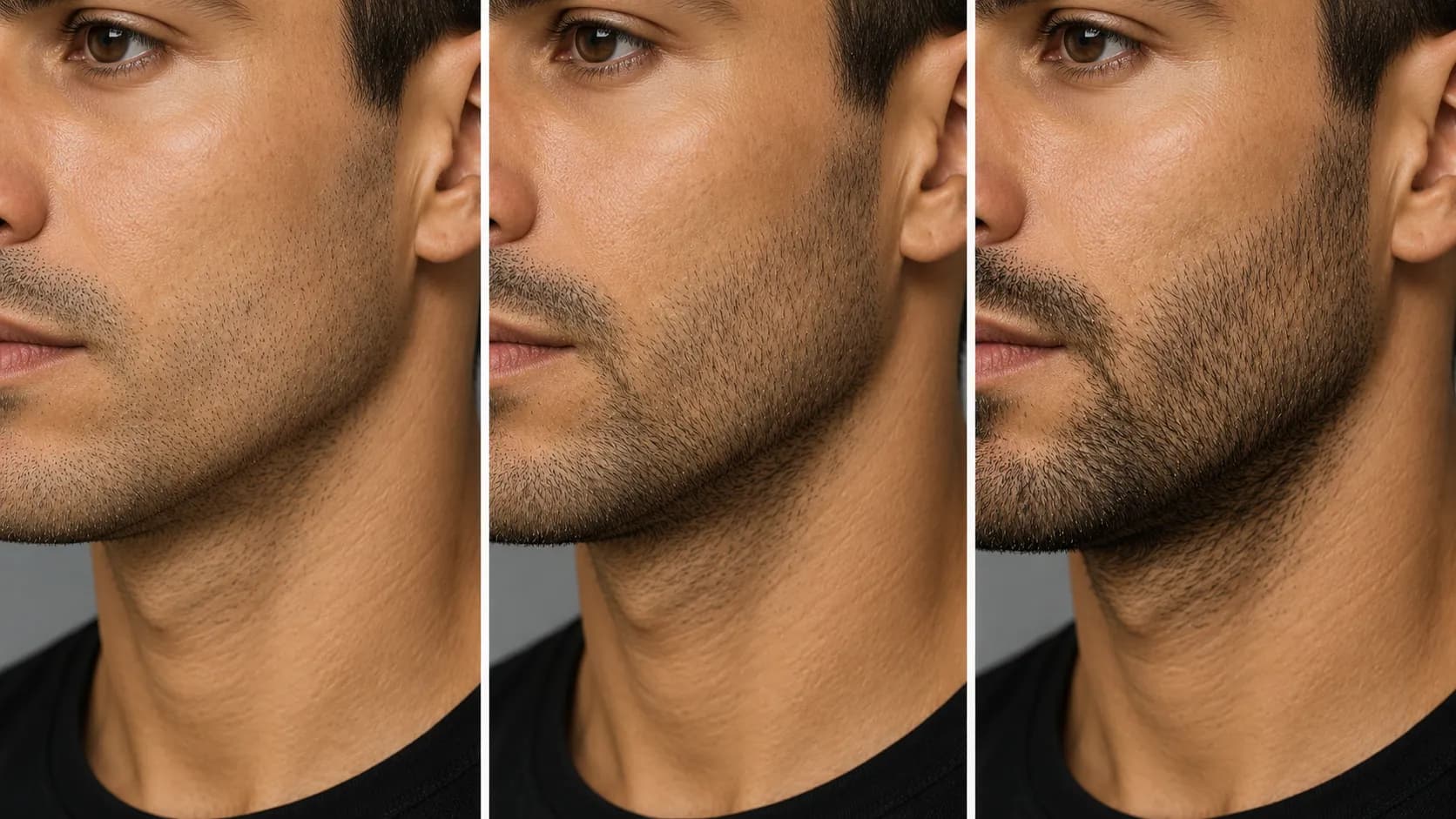
Stubble length is measured in millimeters, and it breaks into three tiers: light at 1 to 2 mm, medium at 2 to 3 mm, and heavy at 4 to 5 mm. Brand guides disagree on the exact cutoffs.
Braun's stubble guide calls 1 to 3 mm a "smart stubble," while The Beard Club puts medium at 3 to 4 mm. The chart below reconciles those ranges into one scale, photographed on a single face so the tiers are actually comparable.
Tier | Length | Dial setting | Days to grow | Best for |
|---|---|---|---|---|
Light | 1 to 2 mm | 0.5 to 2 mm | 2 to 3 days | A subtle shadow, the just-off-the-razor vibe |
Medium | 2 to 3 mm | 2 to 3 mm | 3 to 5 days | The classic 3-day beard, most versatile |
Heavy | 4 to 5 mm | 4 to 5 mm | 7 to 10 days | Rugged, jaw-defining, hides patches best |
The 3 to 4 mm zone is the handover between medium and heavy, so if your trimmer lands there, treat it as the lighter end of heavy. Anything past 5 mm has left stubble behind, and at that point you should trim it as a short beard instead.
The guard or dial number on your trimmer maps to these millimeters. If yours uses guard combs rather than a dial, check the guard number that holds stubble before you start.
On my own face during the test cycle, medium read as a 2.5 mm dial setting at day four of growth. That single number is what I return to every re-cut, which is the whole point of working in millimeters rather than by eye.
How to Set Your Stubble to One Even Length
Setting stubble means trimming your whole face to one chosen length in a couple of deliberate passes, then checking for stragglers. The method that holds up best, echoed by ReadySleek's heavy-stubble guide, is to take the entire beard down to your target first, then refine.
Work on dry hair, because dry strands stand up straighter and cut more evenly than wet ones that lie flat. Stubble is the short end of the wider length playbook, so the same trimmer skills carry over at a tighter setting.
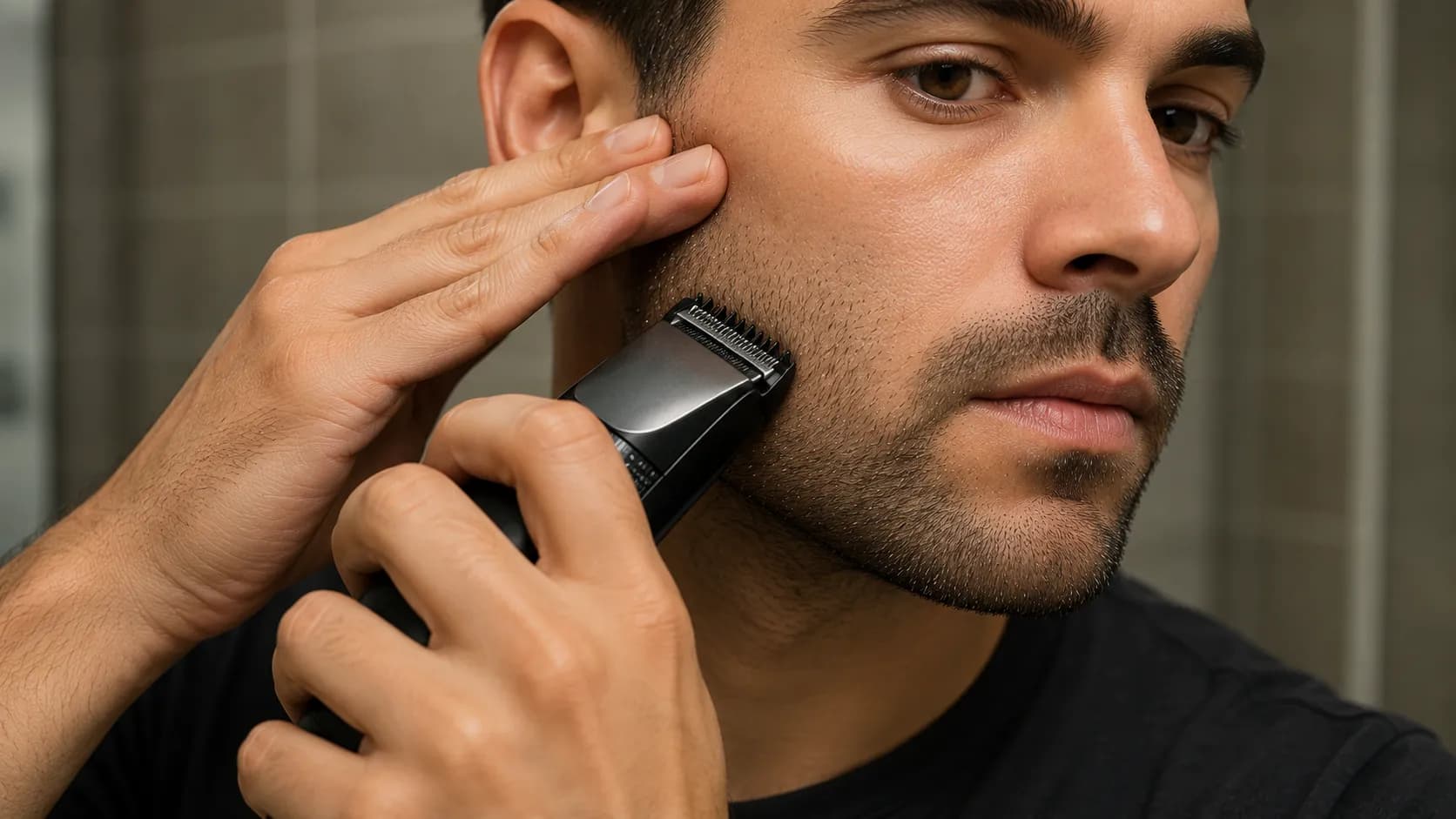
Start dry, with the beard brushed down so every hair sits in its natural direction.
Set the dial or guard to your tier from the chart above, and resist the urge to go shorter on the first pass.
Make one full pass with the grain across the whole face, keeping the trimmer flat to the skin.
Make a second pass against the grain only on the denser zones to even them out, knowing this cuts slightly shorter than the guard number suggests.
Tilt your head under the light and check for stray longer hairs, then spot-trim them at the same setting.
That against-the-grain detail trips people up. Going against the grain pulls each hair upright before the blade meets it, so a 2.5 mm dial left me closer to 2 mm on the chin where I reversed direction.
The catch: the number on your guard is not the number on your face once you trim against the grain, so pick the direction you want and stay consistent across the whole beard.
How Do You Get Stubble Perfectly Even (Especially Around the Jaw)?
Stubble looks uneven at the jaw because a straight trimmer comb sits at a constantly changing angle as it rides over the curve, which changes how close the blade cuts. This is the single most common reason stubble that looked fine on the cheeks reads as patchy along the jawline.
The fix is mechanical, not cosmetic: pull the skin taut, trim against the grain on the curve, and let the tool follow the contour. Get those three right and the length stays consistent all the way around.
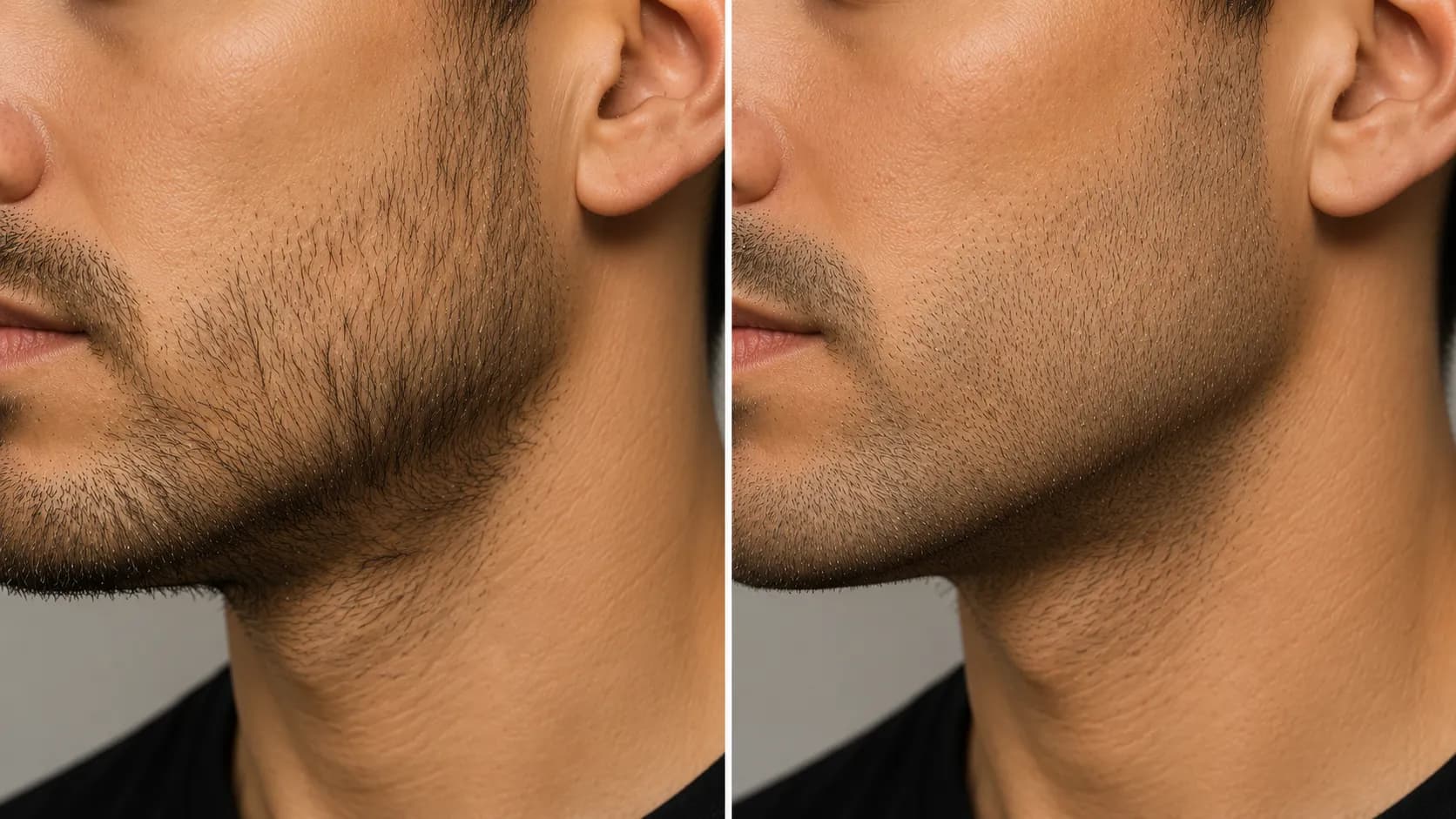
Here is what the measurements showed across the test. With a straight comb and no skin tension, my cheek sat at 2.5 mm but the jaw curve measured 3.3 mm, a gap big enough to read as uneven in daylight.
Spot | Straight comb, skin loose | Skin taut, against the grain |
|---|---|---|
Cheek | 2.5 mm | 2.5 mm |
Jaw curve | 3.3 mm | 2.5 mm |
After stretching the skin and going against the grain on the curve, both spots came in at 2.5 mm. Lift your chin and pull the skin upward with your free hand so the jaw flattens into the blade, a tip ReadySleek's light-stubble guide also recommends for catching trickier hairs.
If a rigid comb still skips the curve, reach for a contour-following stubble trimmer with a flexing or rotary head. This is the part the forums beg for when they ask how to keep stubble even all the way around, and it is geometry you can correct, not technique mysticism.
Neckline and Cheek Lines for a Clean Stubble Edge
The neckline and cheek line are the two borders that separate intentional stubble from genuine five o'clock neglect. For the neckline, place two fingers above your Adam's apple and trim everything below a gentle U that runs ear to ear.
For the cheeks, softly fade the stray hairs above your natural line rather than carving a hard edge. A sharp carved line looks wrong at 2 mm even though it works at 4 to 5 mm.
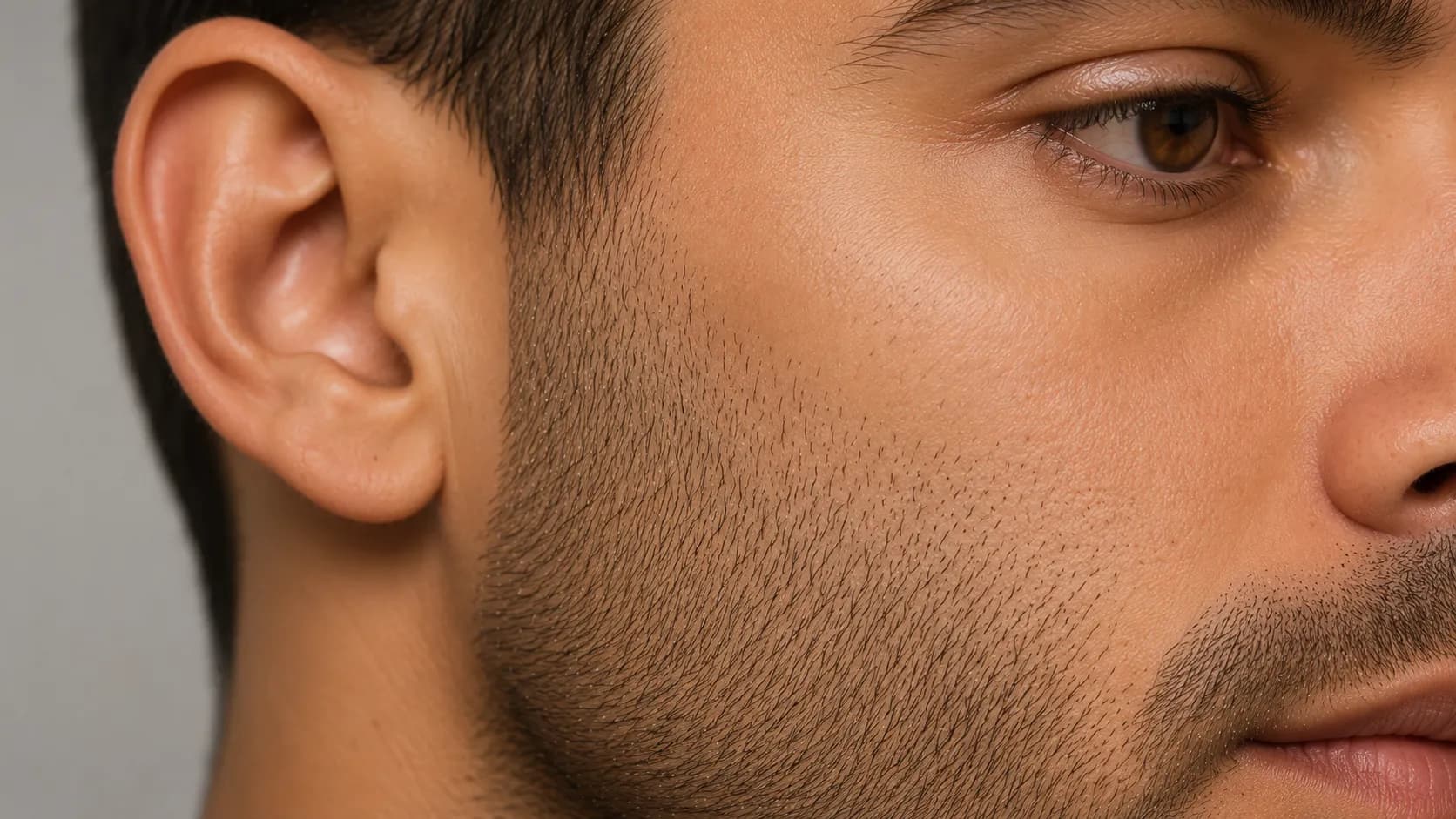
Length changes the rules here. At light and medium tiers the edges should whisper, so trim strays and stop, while heavy stubble has enough length to carry a crisp defined border.
If the neckline is the part you always botch, the full method with the two-finger rule lives in our deep dive on how to find and clean the neckline.
Common mistake: taking the neckline too high. Keep its lowest point two fingers above the Adam's apple, because a neckline at jaw level creates a double-chin look the moment you open your mouth.
How Often to Re-Cut: Why Stubble Is More Upkeep Than a Short Beard
Stubble needs re-cutting every 2 to 3 days, which is more frequent maintenance than a short beard, not less. The reason is simple math: when your whole look depends on a precise 2 to 3 mm, even a single millimeter of overgrowth is visible, whereas a 10 mm short beard absorbs that same millimeter unnoticed.
Lighter tiers demand the most attention of all. ReadySleek notes that maintaining light stubble is actually harder than heavy, because slight growth shows immediately at 1 to 2 mm.
My regrowth log across the cycle put numbers on it. Hair came in at roughly 0.4 mm per day, so a freshly cut 2.5 mm crept past its tier within two days.
Day | Measured length | Status |
|---|---|---|
Day 0, just trimmed | 2.5 mm | On target |
Day 2 | 3.3 mm | Edge of the tier, re-cut due |
Day 4 | 4.1 mm | Past medium, now reads heavy |
Day 6 | 4.9 mm | Short-beard territory |
That gives a clean cadence by tier. Light 1 to 2 mm wants a re-cut every 1 to 2 days, medium 2 to 3 mm every 2 to 3 days, and heavy 4 to 5 mm every 3 to 4 days, while a short beard holds its shape for about a week.
The set-and-forget fantasy does not exist for stubble. If you would rather re-cut weekly, let it grow past 5 mm and trim it as a short beard instead.
For a full cadence breakdown by length, see how often to re-cut by length. Stubble simply sits at the high-maintenance end of that scale.
How to Fix Patchy Stubble
Patchy stubble is fixed by length choice and selective trimming, not by waiting for hair that will not come. The counterintuitive move is to keep your patchy zones slightly longer and trim your dense zones shorter to match, which evens out the visual density.
ReadySleek's method is to trim the thicker areas 0.5 to 1 mm shorter than the thinner ones. On most men that means taking the chin and mustache down while leaving the patchier cheeks alone.
In the test, the patchy cheek read 4.5 mm while the chin and mustache were denser at the same setting. Taking the chin down to 4 mm and leaving the cheek at 4.5 mm made the whole beard look evener, even though the lengths now differed by half a millimeter.
Two more levers help. Lean heavier overall, since 4 to 5 mm hides gaps better than 1 to 2 mm, and keep the stubble clean, because greasy clumped hair always looks patchier than washed hair.
The honest limit: some patches are genetic and will never fill, no matter the technique. When that is the case, a heavier tier or a goatee shape that works around the thin zone beats fighting it.
Best Stubble Length for Your Face Shape
The best stubble length depends on your face shape, with the general rule being to add length where you want fullness and keep it short where you want to slim. Wilkinson Sword's face-shape guide maps the main shapes.
The table below translates that advice into the same three tiers used throughout this guide. These are starting points to test against the mirror, not prescriptions.
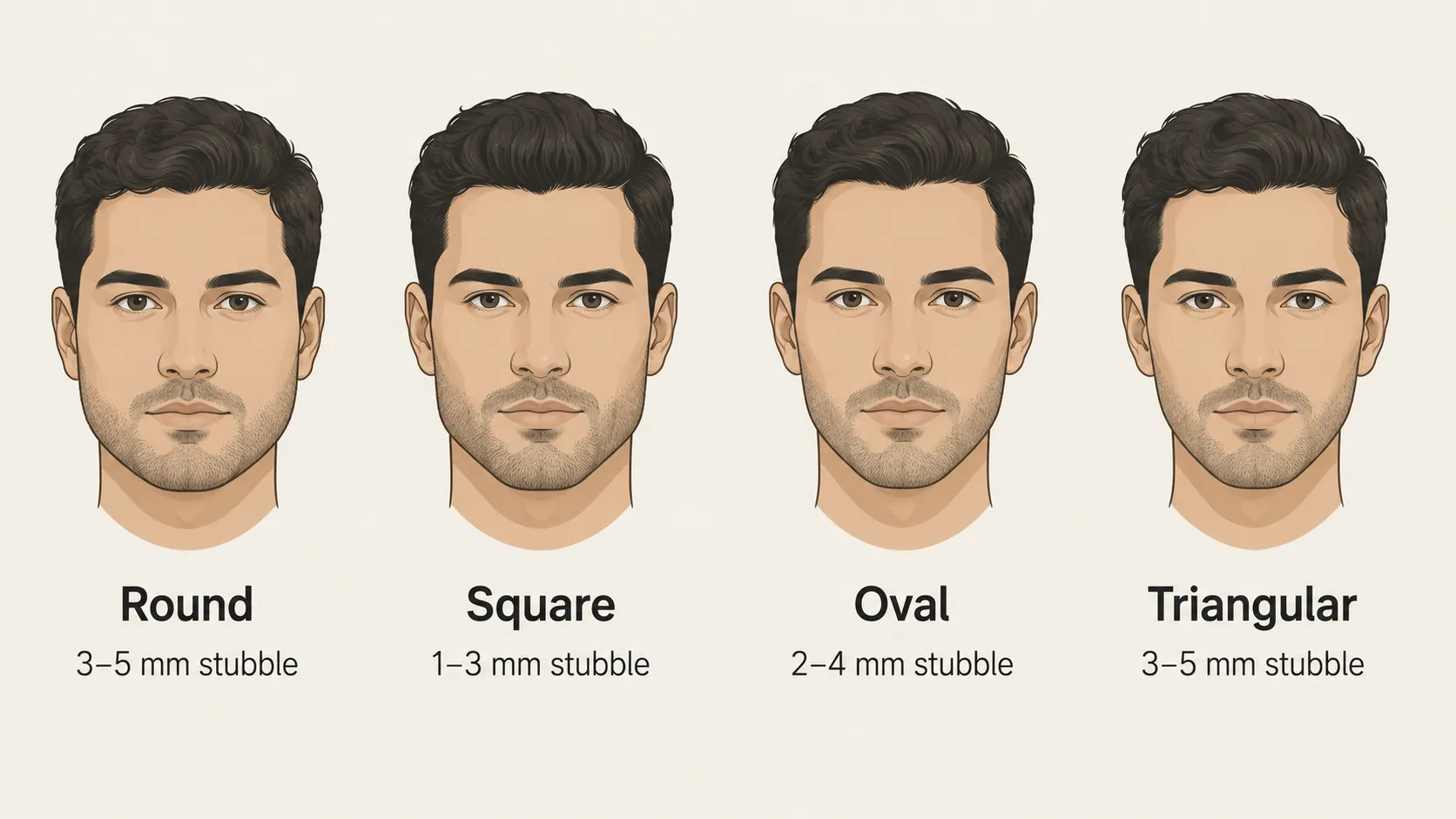
Face shape | Tier and placement |
|---|---|
Round | Medium 2 to 3 mm, shorter on the cheeks and a touch longer on the chin to lengthen the face |
Square | Even 3 to 5 mm all over to soften a strong jaw |
Oval | Any tier, kept even all over, the most forgiving shape |
Triangular or heart | A little fuller at the jaw, lighter on the cheeks to balance a narrow chin |
My own face is oval, and the test confirmed the easy answer: a flat, even 2.5 mm worked from every angle with no length juggling. If you are unsure of your shape, the safest default is an even medium tier, then adjust once you see how it sits.
For these looks in context, you can browse the full styles gallery.
Stubble FAQs
What length should stubble be in mm?
Stubble runs from about 1 to 5 mm. Light is 1 to 2 mm, medium is 2 to 3 mm, and heavy is 4 to 5 mm. Past 5 mm it becomes a short beard, and most men land on medium for the classic 3-day look.
How do you keep stubble perfectly even?
Trim the whole face to one length on dry hair, then handle the jaw separately. Pull the skin taut, trim against the grain on the curve, and use a contour-following head so the blade stays the same distance from the skin all the way around.
How often should you trim stubble?
Every 2 to 3 days for medium, every 1 to 2 days for light, and every 3 to 4 days for heavy. Stubble grows back into view fast at these lengths, so it needs re-cutting more often than a short beard.
Is stubble more attractive than a full beard?
Research leans toward stubble. In a 2013 study, Dixson and Brooks found women rated heavy stubble most attractive among facial-hair stages. A later study of 8,520 women, also led by Dixson, found stubble and beards soften the effect of extreme face shapes, and a broader review of facial-hair preferences confirms results are mixed.
What guard number is stubble?
It depends on your trimmer, but stubble usually sits at the lowest dial settings, roughly 0.5 to 5 mm. A dial in 0.5 mm steps is more precise for stubble than swapping bulky guard combs.
Should you trim stubble dry or wet?
Dry. Dry hair stands up straighter and cuts more evenly, while wet hair lies flat and trims unpredictably, so save wet work for a razor finish on the neck and cheek borders.
How long does it take to grow stubble?
About 3 to 5 days for light to medium, and 7 to 10 days for heavy, though growth rate varies by person. Grow it slightly longer than your target, then trim down to an even length.
The Bottom Line on Shaping Stubble
The men who get stubble right are the ones who stop thinking of it as a skipped shave and start treating it as a length they own. Choose your tier in millimeters, set the whole face to that one number, and put your real effort into keeping it even where the jaw curves.
The trade-off is honest. Learning how to shape a stubble beard buys you a sharp, low-effort look, but it asks for a quick re-cut every couple of days rather than a weekly tidy.
Dial in your tier, fix the jawline geometry, and the rest is just showing up at the mirror on schedule.
Summarize with AI
Keep reading
Related articles
 Styles, Shapes & Length Guides
Trim your beard dry so it dries even; wet hair stretches then shrinks. Go wet only for a razor lineup in the shower, plus wash and comb order.
 Styles, Shapes & Length Guides
Taper your beard at home with the 4-guard step-down method - drop one guard at a time for a clean low, mid, or high gradient without bowl-beard lines.
 Styles, Shapes & Length Guides
Keep the sides short and the chin long — the opposite of a haircut — to slim a round face. A barber-reviewed shaping guide by face shape, with before/after.
 Styles, Shapes & Length Guides
Trim lines and flyaways, not length, to stay sharp while growing your beard. A barber-reviewed 4-stage timeline to grow out without losing an inch.
Comments
Moderated for quality. Share a correction, ask a follow-up, or tell us what worked for you - every comment is reviewed before it goes live.